Ordering custom football socks for a club, academy or teamwear program involves more than approving a logo and choosing a color.
Before a bulk order begins, buyers need to confirm the physical sample: fit, size, yarn, compression, cushioning, logo placement, grip position and packaging.
After the first production run, another challenge begins: how do you reorder the same football socks consistently for the next season, new players or additional teams?
This football sock sample reorder guide explains how clubs, academies and teamwear buyers can manage both stages—from approving the first sample to planning repeat orders with fewer delays and fewer specification mistakes.
Football Sock Sample & Reorder Process at a Glance
A practical custom football sock program usually follows this sequence:
Design Brief → Sample Development → Fit & Specification Review → Sample Approval → Bulk Production → Delivery → Inventory Monitoring → Reorder
For buyers, two stages deserve particular attention:
Sample approval
This determines exactly what the factory should reproduce during bulk production.
Reorder planning
This determines whether future orders remain consistent and arrive before existing stock runs out.
A successful football sock supplier should therefore support both product development and repeat production.
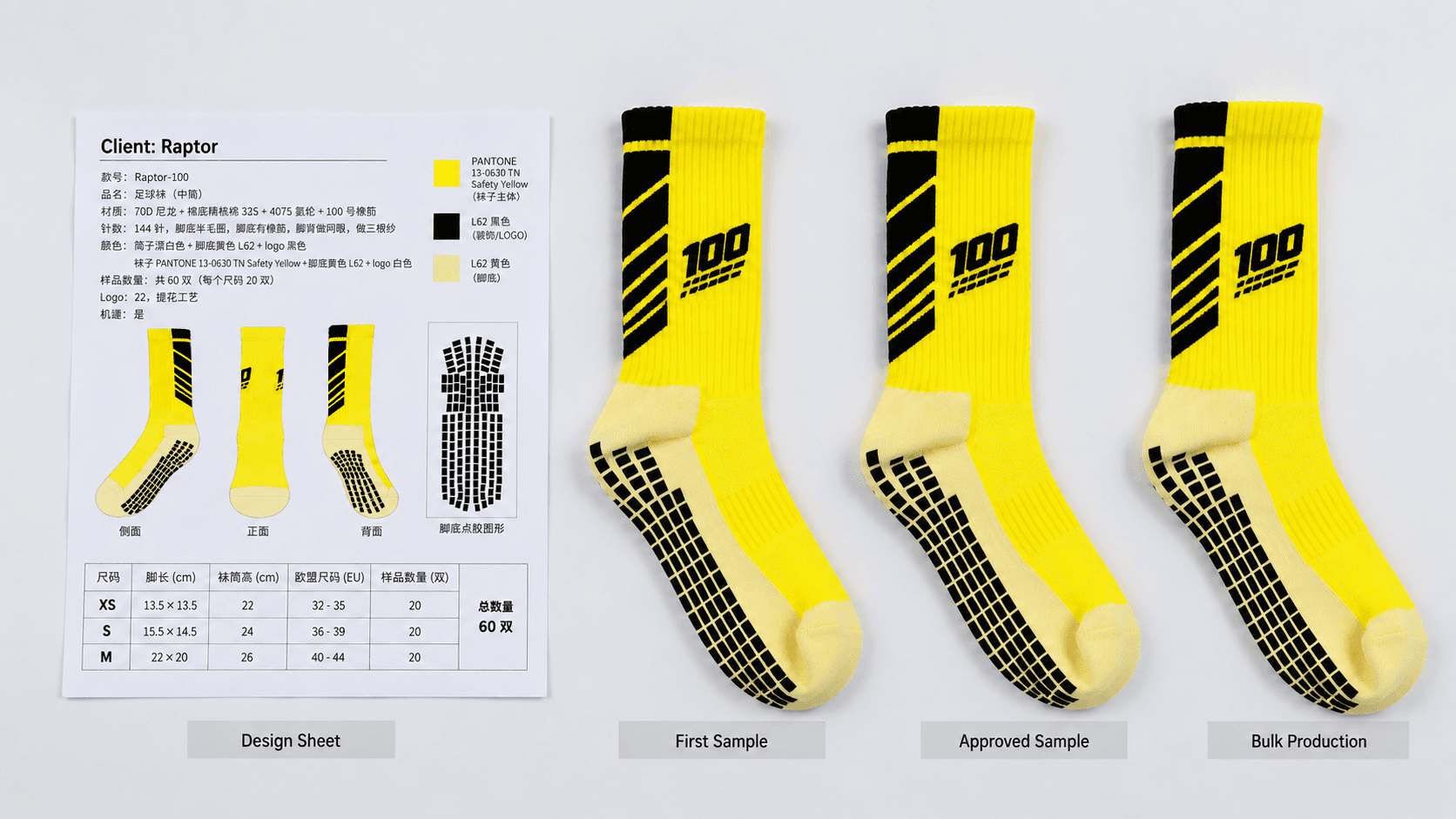
Why Is the Sample So Important for Custom Football Socks?
A digital mock-up is useful for confirming appearance, but it cannot fully confirm:
- Actual sizing
- Sock stretch
- Compression
- Cushioning
- Yarn feel
- Toe construction
- Heel position
- Cuff tightness
- Grip feel
- Silicone position
- Logo distortion when worn
That is why a physical sample should be treated as a production reference, not simply as a sales sample.
Once approved, the sample helps define what should be reproduced in bulk.
What Should Be Confirmed Before Sampling Starts?
A clear product brief reduces unnecessary sample revisions. Before development, send the manufacturer as much information as possible.
1. Sock Type
- Football grip socks
- Crew performance socks
- Knee-high football socks
- Training socks
- Match socks
Do not simply request “custom football socks.” Different constructions require different knitting programs and sizing.
2. Club Logo and Artwork
Provide clear artwork wherever possible. Vector formats such as AI, EPS, SVG or editable PDF are preferable to screenshots.
Also confirm where the branding should appear:
- Side of cuff
- Front
- Back
- Foot
- Sole grip
- Packaging
Logo position can change visually once the sock is worn, so this should also be reviewed on the physical sample.
3. Team Colors
If color accuracy is important, provide a clear reference such as a Pantone reference, existing jersey, fabric swatch or approved physical sample.
Do not rely only on how a color appears on a phone or computer screen. Different displays can show the same color differently.
4. Size Range
Before sampling, decide which player groups need to be covered, for example Kids, Youth, Adult S/M and Adult L/XL.
The final ranges depend on the specific sock construction and manufacturer’s size chart. For clubs and academies, it is useful to prepare the size breakdown before bulk production rather than after sample approval.
5. Performance Requirements
- Arch compression
- Mesh ventilation
- Heel reinforcement
- Toe reinforcement
- Terry cushioning
- Thin boot-compatible foot construction
- Silicone sole grip
Tell the supplier which features are essential. This prevents the sample from becoming overloaded with features that your players do not actually need.
6. Grip Requirements
- Grip material
- Grip color
- Coverage
- Pattern
- Logo integration
- Approximate thickness
You may choose an existing factory grip pattern or fully custom grip artwork.
A custom logo incorporated into the silicone pattern can strengthen brand identity, but the design should still provide practical sole coverage.
Build the player size breakdown before sample approval with our Custom Football Socks Sizing Guide.
What Should You Check When the Football Sock Sample Arrives?
Do not approve a sample after looking at it for only a few minutes. Evaluate it systematically.
1. Overall Appearance
- Team colors
- Logo
- Stripe position
- Sock height
- Knit pattern
- Grip artwork
- Packaging
Compare the physical product with the approved artwork.
2. Foot Fit
- Heel alignment
- Toe position
- Excess fabric
- Stretch
- Compression
- Movement inside the boot
A football sock should not be evaluated only when lying flat on a table. The real question is how it behaves during use.
3. Cuff and Compression
The cuff should hold the sock in position without creating uncomfortable pressure.
- Arch compression
- Midfoot support
- Elastic recovery
If compression is too loose, the sock may move. If it is too tight, players may find it uncomfortable during longer sessions.
4. Cushioning
Check whether cushioning matches the intended use. Some football buyers prefer thin and close-fitting socks because the sock is worn inside a tight boot. Others want additional cushioning around the heel, toe or forefoot.
5. Breathability
Look at the mesh and ventilation areas. For technical football socks, breathable knit zones can help reduce unnecessary bulk and improve comfort during training and matches.
Make sure these zones remain correctly positioned when the sock is worn.
6. Logo Appearance When Worn
A logo that looks perfect on a flat sock may stretch or distort on the leg.
- Logo proportions
- Position
- Visibility
- Orientation
If the sock design includes club initials, numbers or other graphics, review them in the same way.
7. Silicone Grip Placement
For football grip socks, the grip should align with the areas of the foot intended to contact the inside of the boot.
- Forefoot coverage
- Heel coverage
- Midfoot coverage
- Edge position
- Logo position
Grip that sits too far toward one side may not perform as intended.
.png&w=3840&q=75)
.png&w=3840&q=75)
.png&w=3840&q=75)
.png&w=3840&q=75)
.png&w=3840&q=75)
Test Football Grip Socks Inside Actual Boots
This step is particularly important. The grip sock may feel comfortable when worn alone but behave differently inside a football boot.
Ask testers to wear the sample with their normal boots and evaluate:
- Boot fit
- Grip feel
- Sock movement
- Pressure points
- Thickness
- Comfort during direction changes
For clubs, testing during an actual training session gives more useful feedback than only walking around indoors.
Compare construction and grip options for Custom Grip Socks.
.png&w=3840&q=75)
.png&w=3840&q=75)
Use More Than One Player for Fit Testing
One player’s feedback should not define an entire team program.
If possible, test different shoe sizes, different foot shapes, different boot models and players at both ends of a size range.
For example, if one sock size covers an intended range such as EU 39–42, test players closer to both the smaller and larger ends.
Should You Wash the Sample Before Approval?
For reusable team products, it is useful to understand how the sock behaves after washing.
- Shrinkage
- Stretch recovery
- Color
- Logo
- Grip adhesion
- Sock shape
Follow the intended care instructions. For technical or grip socks, repeated washing can reveal issues that are not visible on a new sample.
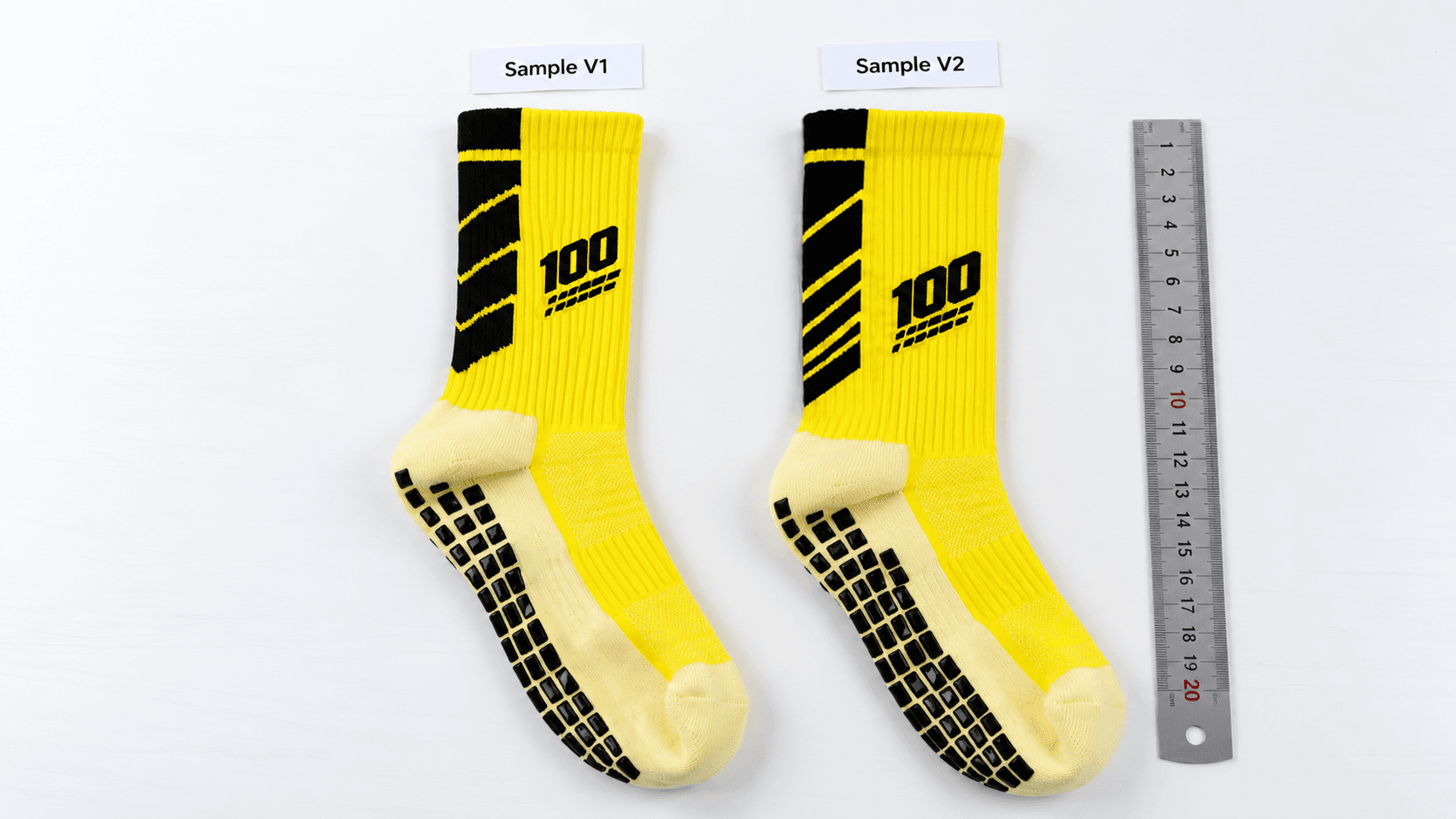
First Sample vs Revised Sample
It is normal for some custom projects to require revisions.
- Smaller logo
- Different stripe width
- Increased compression
- Reduced cushioning
- Different yarn color
- Modified grip coverage
- Adjusted sock height
The important thing is to identify these changes before bulk production.
A revised sample may extend development time, but correcting the product during sampling is much less costly than correcting thousands of finished pairs.
Create a Sample Approval Checklist
| Item | Approved? | Notes |
|---|---|---|
| Sock style | □ | |
| Size / fit | □ | |
| Team colors | □ | |
| Club logo | □ | |
| Sock height | □ | |
| Compression | □ | |
| Cushioning | □ | |
| Mesh / ventilation | □ | |
| Heel & toe | □ | |
| Grip pattern | □ | |
| Grip position | □ | |
| Packaging | □ |
Do not approve bulk production until the essential items are confirmed.
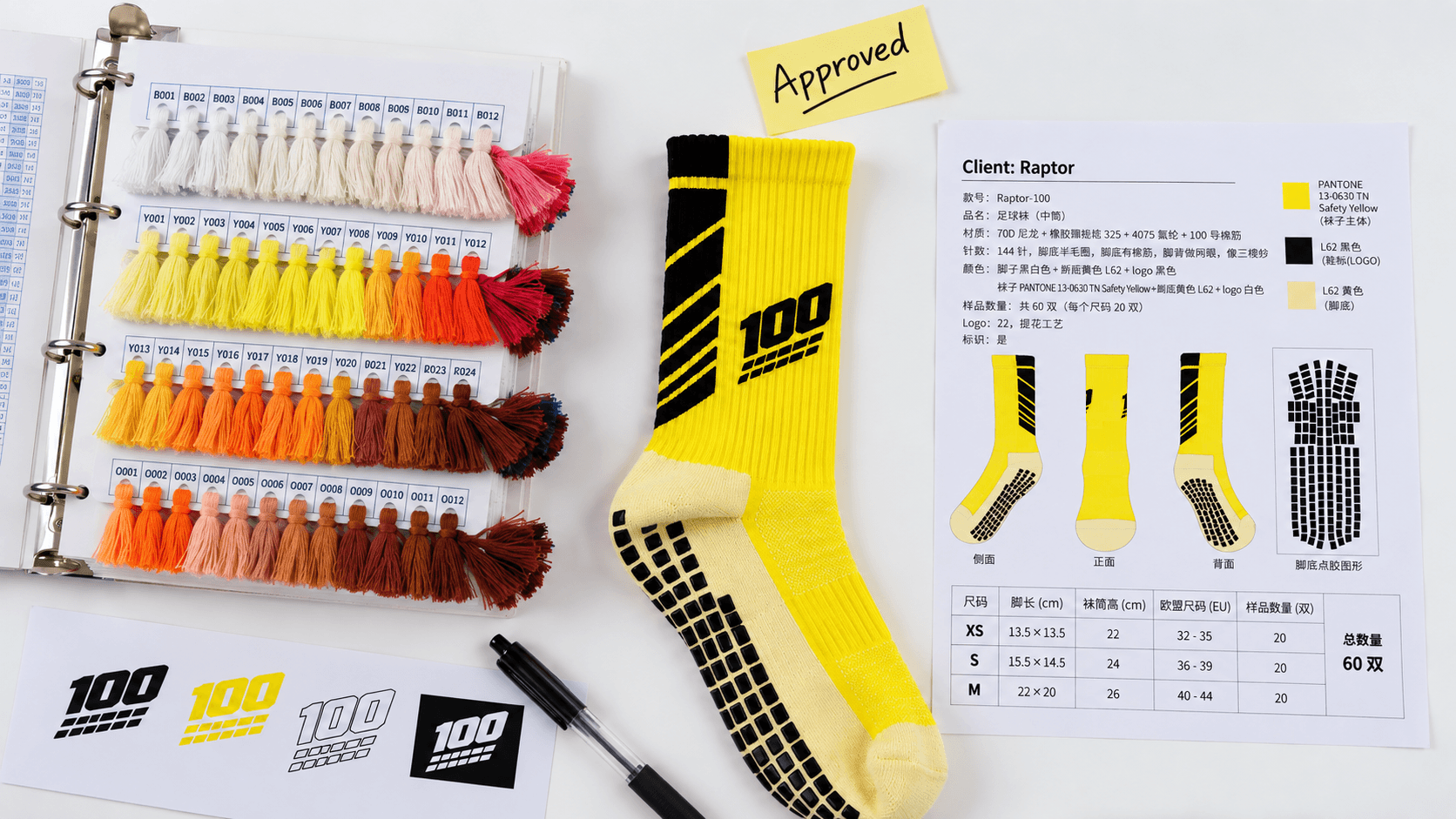
Keep an Approved Reference Sample
Once the final sample is approved, keep at least one physical reference sample.
Ideally, the buyer keeps one and the manufacturer keeps one.
This gives both sides a reference for bulk inspection, future reorders, color matching, logo placement, construction and packaging.
For repeat programs, the approved sample becomes an important part of production consistency.
What Should Be Locked Before Bulk Production?
- Product style
- Yarn composition
- Colors
- Logo artwork
- Logo position
- Sizes
- Size quantities
- Sock measurements
- Compression
- Cushioning
- Grip pattern
- Grip color
- Packaging
- Quantity
Once this information is approved, avoid unnecessary changes during manufacturing. Late changes can affect cost, lead time and production consistency.
Compare order-size tradeoffs in our guide to 50 vs 100 vs 500 Pairs MOQ.
Why Reorder Planning Matters for Football Clubs
Many clubs focus entirely on the first order, but football programs rarely end after one shipment.
- New players
- Replacement pairs
- Academy intake
- Additional squads
- Tournament teams
- Staff
- Club retail
- Next season
A good supplier relationship therefore needs to support reliable repeat production.
When Should a Football Club Reorder Socks?
Do not wait until stock reaches zero.
Your reorder decision should consider current inventory, average usage, production lead time, shipping time and safety stock.
Average Weekly Usage × Replenishment Lead Time + Safety Stock = Reorder Point
Example: if a club uses or sells 15 pairs per week and a repeat order requires 8 weeks from confirmation to arrival, expected demand during that period is 15 × 8 = 120 pairs.
If the club wants 30 pairs of safety stock, the reorder point becomes 150 pairs.
This is an illustrative calculation. Actual lead time should be confirmed with the supplier.
Why Repeat Orders Can Be Easier Than the First Order
The first order normally requires product development. A repeat order may already have:
- Approved knitting program
- Approved yarn colors
- Size specifications
- Logo artwork
- Grip artwork
- Packaging files
- Packing requirements
This can reduce development work. However, clubs should never assume that repeat orders require no confirmation.
- Quantity
- Size breakdown
- Colors
- Packaging
- Required delivery date
- Whether any specification has changed
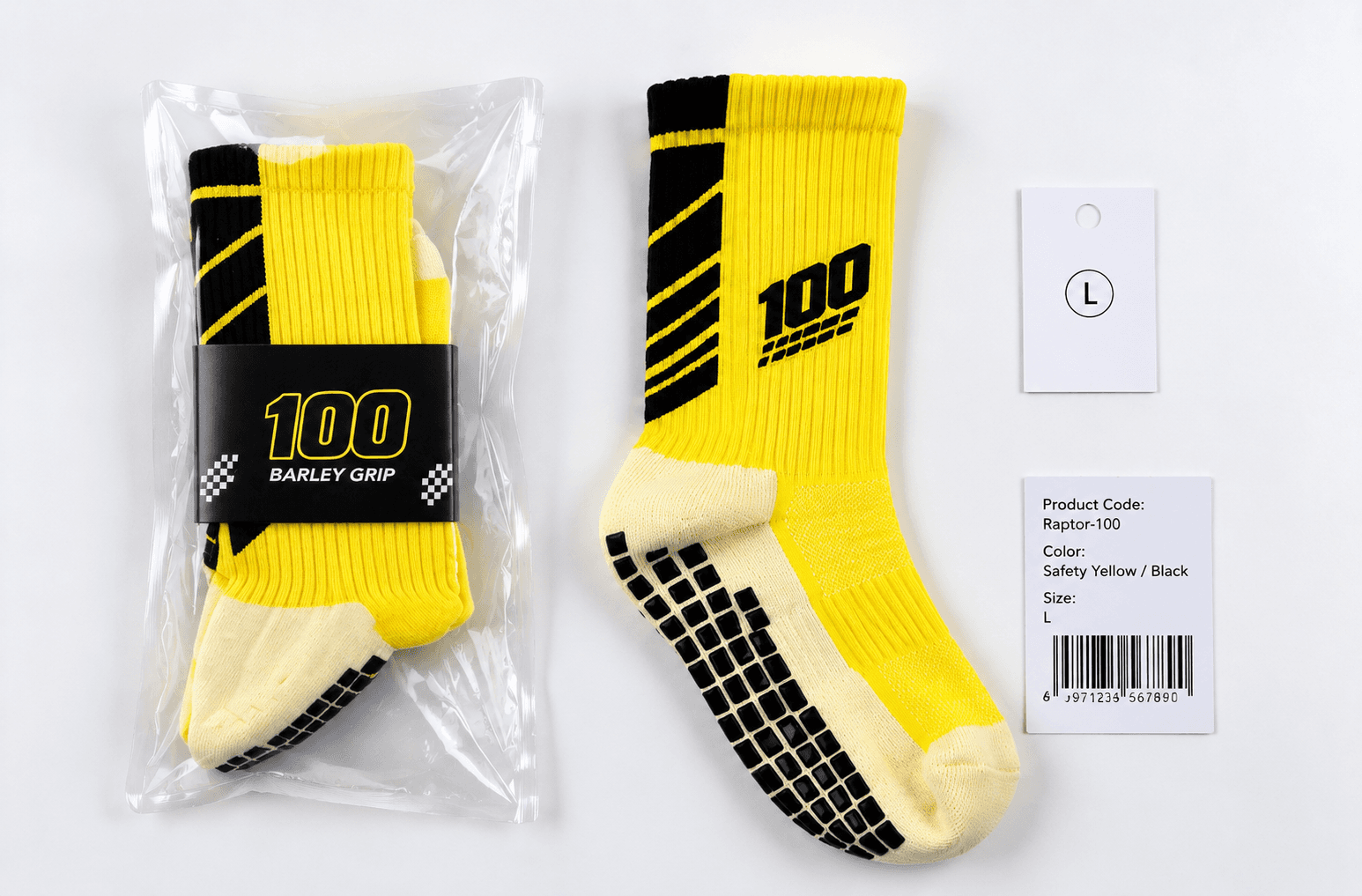
Use a Product Code for Every Approved Football Sock
For teamwear buyers managing multiple clubs, a product code is extremely useful.
For example, FC-001-WHT-SM could represent Football Club 001, White, Size S/M.
A product code can link to artwork, knitting program, size specification, grip pattern and packaging. This reduces confusion when a buyer reorders several products at once.
How Teamwear Buyers Should Manage Multiple Clubs
Teamwear distributors may supply dozens of clubs. Instead of treating every reorder as a completely new project, create a specification record for each club.
| Club | Style | Color | Size | Product Code |
|---|---|---|---|---|
| Club A | Grip Crew | White | S/M | A-GC-W-SM |
| Club A | Grip Crew | White | L/XL | A-GC-W-LXL |
| Club B | Knee High | Navy | Youth | B-KH-N-Y |
| Club B | Knee High | Navy | Adult | B-KH-N-A |
This creates a much cleaner repeat-order workflow.
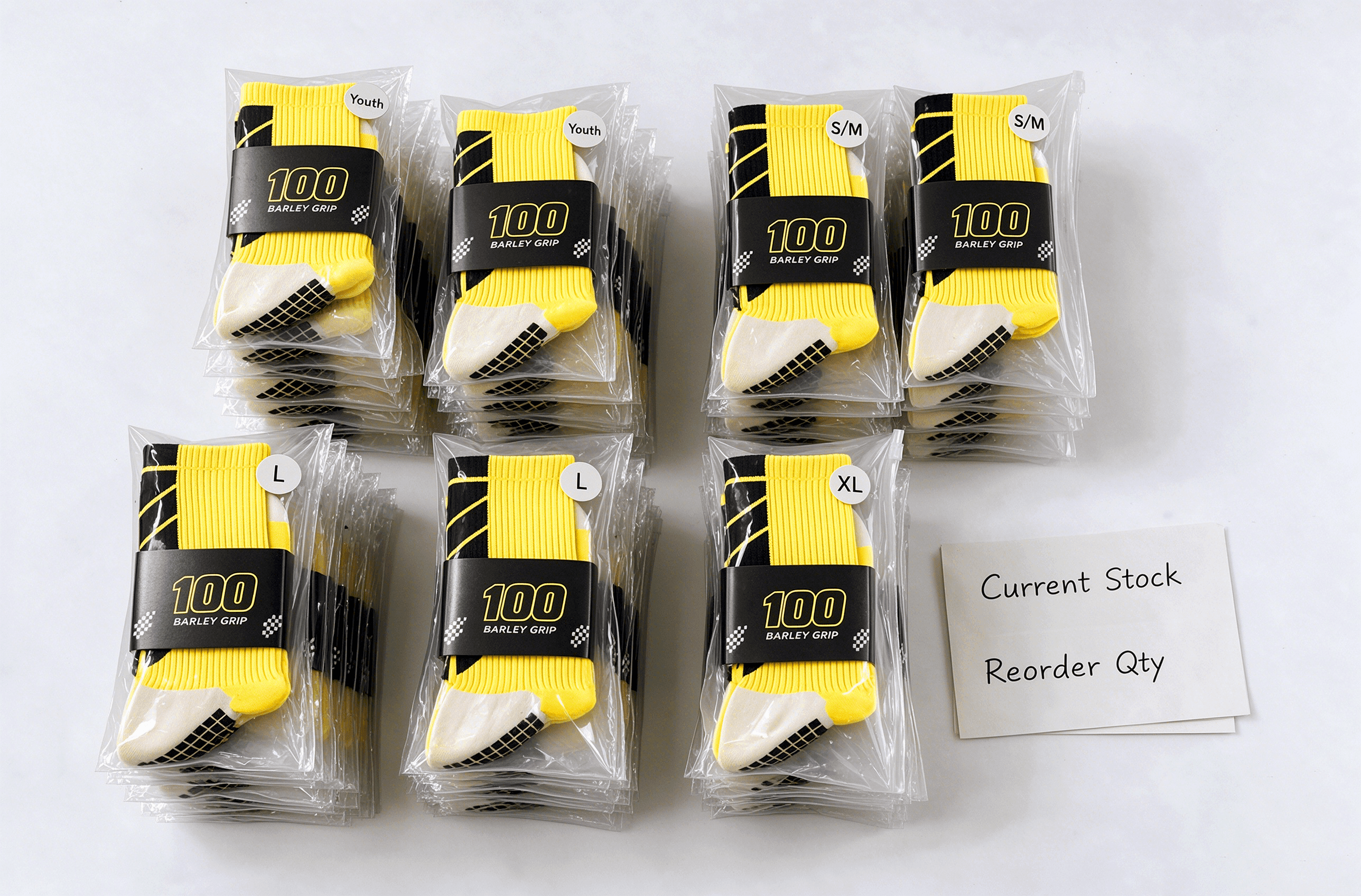
Track Size Consumption, Not Just Total Inventory
A club may have 100 pairs in stock and still have an inventory problem.
For example, stock might be 5 Youth, 15 S/M and 80 L/XL.
If S/M is the fastest-moving size, total inventory does not tell the whole story.
Reorder planning should be managed by size, not only by total pairs.
The Same Applies to Colors
A club may use home kit socks, away kit socks and training socks. Each color can have a different demand rate.
Instead of asking “How many football socks do we have left?”, ask “How many pairs remain by style, color and size?”
Seasonal Reorders Need Earlier Planning
Football demand is not always evenly distributed throughout the year.
- Season launch
- New player registration
- Pre-season
- Tournament periods
- Academy intake
- Club store launches
If the order must arrive before a specific event, work backward from the required delivery date.
- Quantity confirmation
- Material preparation
- Production
- QC
- Packing
- Shipping
Urgent production and urgent freight are usually more expensive than planned replenishment.
Work backward from the delivery date using our guide to Custom Socks Lead Time.
What If You Want to Change the Design on a Reorder?
Not every repeat order is identical. A club may want to change a sponsor, logo, season number, stripe, color, grip artwork or packaging.
Once these changes are introduced, the order should be treated as a revised product, not blindly as an identical repeat order.
Usually Minor
- Packaging text
- Barcode
- Quantity allocation
May Require Review or New Sample
- New club logo
- Different sock construction
- Different sizing
- New grip pattern
- Major color change
- Different compression or cushioning
Ask the supplier before assuming the old sample still represents the new product.
Reorders for New Players
Clubs frequently add players after the original team order.
Keep records of player size, team, product code and sock color. Then additional pairs can be added to the next reorder.
For academies with frequent player movement, maintaining a small amount of safety stock in the most common sizes can reduce the need for very small emergency orders.
Avoid Emergency Reorders
Emergency orders often create unnecessary cost.
- Air freight instead of slower shipping
- Production schedule pressure
- Insufficient time for QC
- Limited ability to correct errors
A simple inventory system can reduce this risk. Review stock regularly, for example every month or at defined points during the season depending on usage.
Sample Cost vs Bulk Order Risk
Some buyers hesitate to pay for samples because they want to reduce initial cost.
But the sample should be compared against the financial risk of a bulk production mistake.
- Wrong fit
- Incorrect logo
- Poor grip positioning
- Uncomfortable cuff
- Wrong color
If a sample reveals these issues before a large order is produced, the development cost has done its job.
For clubs and teamwear buyers, sampling should be considered part of risk control.
Should You Order a Sample Again for Every Reorder?
Not necessarily. If all specifications remain unchanged and the supplier retains the approved production information, a full new development cycle may not be necessary.
However, consider a new sample or pre-production confirmation when:
- Materials change
- Design changes
- Size specification changes
- Grip pattern changes
- New packaging is introduced
- A long time has passed since the previous production
The goal is not to sample unnecessarily. It is to make sure the new order still matches what the club expects.
Football Sock Reorder Checklist
Product
- Same style?
- Same materials?
- Same logo?
- Same colors?
- Same grip?
- Same packaging?
Quantity
- Total pairs?
- Quantity by size?
- Quantity by color?
Timing
- Required delivery date?
- Production lead time?
- Shipping time?
Inventory
- Current stock?
- Fastest-selling sizes?
- Replacement stock needed?
Documentation
- Correct product code?
- Correct artwork?
- Latest size specification?
This simple checklist can prevent many repeat-order mistakes.
Example: Club Reorder Planning
A club originally orders 300 pairs split into Youth 60, Adult S/M 150 and Adult L/XL 90.
After several months, remaining inventory is Youth 25, Adult S/M 20 and Adult L/XL 50.
The mistake would be to reorder the original 20% / 50% / 30% split automatically.
Actual demand shows Adult S/M is moving much faster. The next order should use consumption data to adjust the size mix.
That is one of the biggest benefits of repeat-order history.
.png&w=3840&q=75)
.png&w=3840&q=75)
What Information Should You Send for a Football Sock Reorder?
- Club name or project reference
- Previous product code
- Previous order reference, if available
- Sock style
- Color
- Quantity by size
- Packaging requirements
- Required delivery date
- Any requested changes
If there are no changes, state clearly: Repeat previous approved specification.
If there are changes, list them separately. Do not hide changes inside a general reorder request.
Frequently Asked Questions
How long does a custom football sock sample take?
Sample timing depends on the construction, materials, logo, sizes and grip requirements. Confirm the current development schedule with the manufacturer before planning your club launch.
Should football clubs test a sample before bulk production?
Yes. A physical sample helps confirm fit, sizing, logo placement, construction, grip and comfort before a larger order is produced.
How many football sock samples should we order?
For a simple project, one representative sample may be enough to review appearance and construction. Larger academy programs covering very different size ranges may benefit from testing representative youth and adult sizes.
Can we change the football sock after receiving the sample?
Yes, but significant revisions may require another sample and additional development time.
Are repeat football sock orders faster?
They can be easier to plan because the design and specification are already approved, but material availability, quantity and current production capacity still affect lead time.
Should a club reorder the same size ratio every time?
Not automatically. Use actual consumption data from the first order to adjust future size quantities.
Do we need a new sample for every reorder?
Not necessarily if the specification is unchanged. A new sample may be appropriate if materials, design, sizing, grip or packaging changes.
What should teamwear buyers save for future reorders?
Keep the approved sample, artwork, product code, size specification, colors, packaging files and previous order records.
Build a Repeatable Football Sock Program, Not Just a One-Time Order
The most successful teamwear programs treat custom football socks as a repeat product.
The first sample establishes the standard. The first bulk order provides real player and inventory data. The next reorder uses that information to improve size allocation, stock levels, delivery timing and purchasing efficiency.
For clubs and academies, that means fewer sizing problems and fewer emergency orders. For teamwear buyers, it creates a more scalable way to manage multiple club accounts.
PeakMotion supports custom football sock development from sampling and size confirmation through bulk production and repeat supply.
If you are developing a football sock program, send us:
- Club logo
- Sock reference or artwork
- Size requirements
- Quantity
- Grip requirements
- Packaging
- Delivery destination
- Required delivery date
When your brief is ready, review our Football Socks Manufacturer.
Plan your club order
Planning a Football Sock Sample or Reorder?
Send your design, previous specification or size breakdown. Include your club logo, sock type, grip requirements, estimated quantity, packaging and target delivery date.