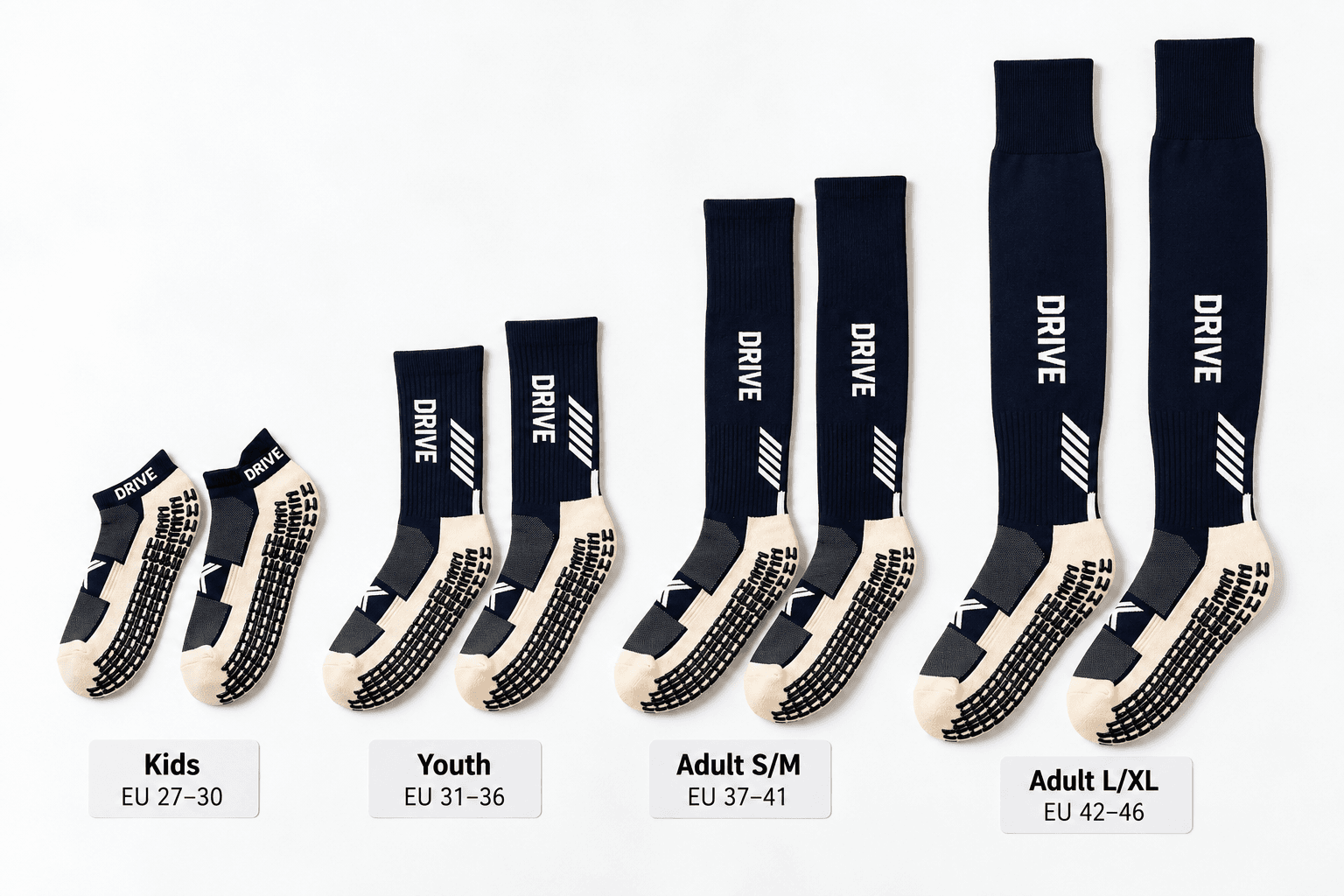
Choosing sizes for an entire football squad is more complicated than choosing one pair for one player. A club order can include children, youth players and adults with different shoe sizes, calf sizes and fit preferences.
This guide explains how to collect player information, plan quantities by size, account for minimum order requirements and reduce fitting problems before bulk production.
Why sizing matters for team orders
For an individual buyer, a sizing mistake affects one player. For a club order, the same mistake can affect dozens or hundreds of players. Excess fabric, sliding, uncomfortable compression, misplaced heels or toes, and grip zones that do not align can all lead players to modify or replace team-issued socks.
The aim is to create the right size mix for the whole team, rather than choosing one “average” size.
Football sock size vs shoe size: where should clubs start?
Shoe size is usually the most practical starting point. Players know it, and a manager can collect it quickly before converting it to the manufacturer’s available sock sizes.
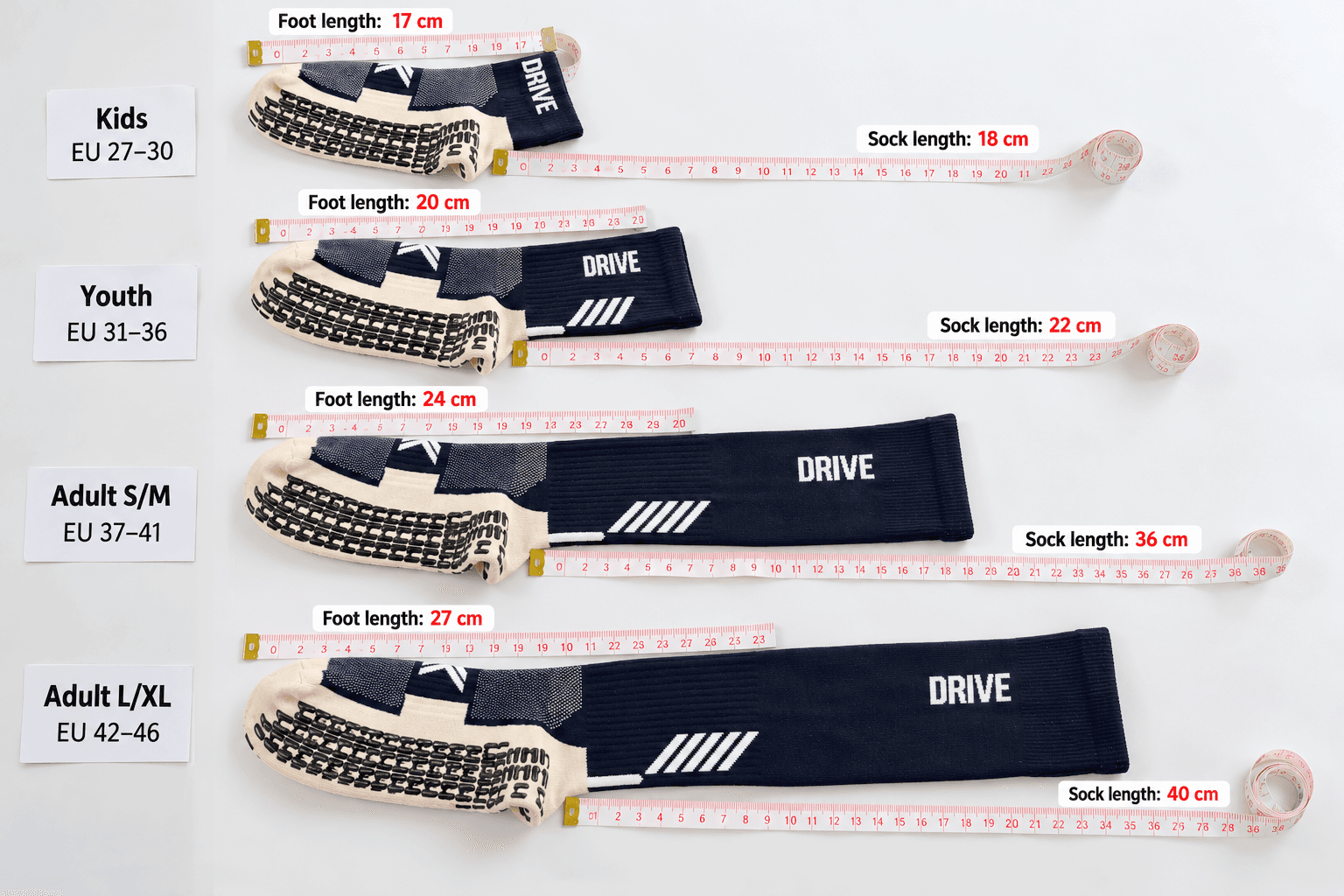
| Sock size | Illustrative EU shoe size | Typical group |
|---|---|---|
| Kids | EU 30–34 | Younger academy players |
| Youth | EU 35–38 | Older youth players |
| Adult S/M | EU 39–42 | Teen and adult players |
| Adult L/XL | EU 43–46 | Adult players |
These table ranges and the ranges printed in the supplied photos are separate illustrative examples, not a universal size chart. Confirm the exact chart for your chosen construction before assigning any player to a size.
Kids, youth and adults need different planning
A senior team may need only two adult sizes. An academy can include U8 through U18 squads, so the size mix becomes more varied. Age can help organize an order, but two players of the same age may wear different shoe sizes. Collect both the age group and each player’s shoe size.
.png&w=3840&q=75)
.png&w=3840&q=75)
.png&w=3840&q=75)
.png&w=3840&q=75)
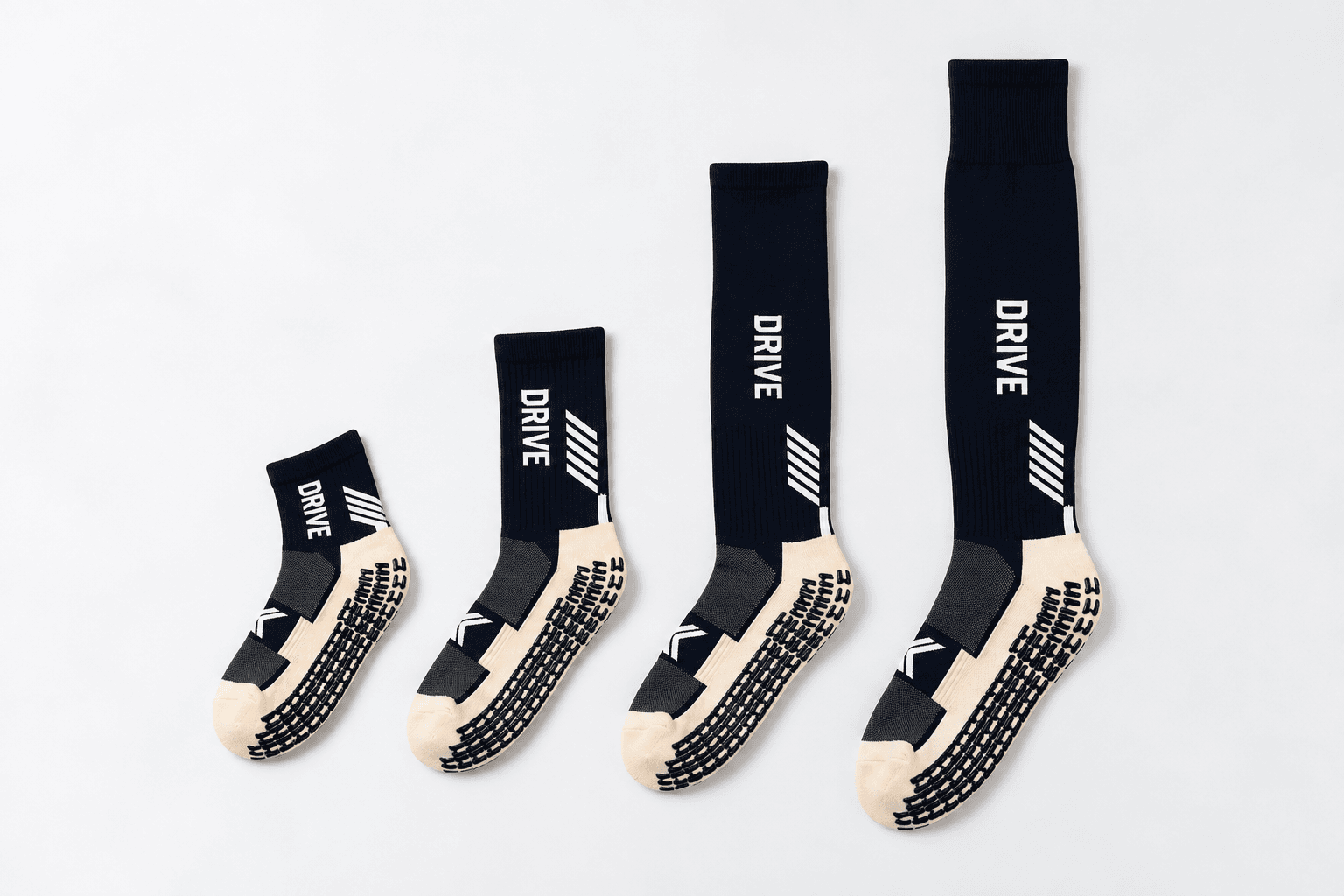
The labels shown on these product and packaging examples illustrate size identification. They are not a substitute for a confirmed manufacturer chart.
Collect player sizes before requesting a quote
Make a simple sizing sheet for each squad, then convert shoe sizes using the chart for the chosen sock style. Larger clubs can send the manufacturer a consolidated quantity by size instead of individual player names.
| Player | Team | EU shoe size | Required sock size | Pairs |
|---|---|---|---|---|
| Player 01 | U12 | EU 36 | Youth | 2 |
| Player 02 | U12 | EU 38 | Youth | 2 |
| Player 03 | U12 | EU 39 | Adult S/M | 2 |
| Player 04 | U12 | EU 41 | Adult S/M | 2 |
Plan pairs per player and the size breakdown
Match day, training, home and away kits, tournaments, merchandise and replacement stock can each change the quantity required. For 25 players receiving two pairs each, the starting need is 50 pairs. Add spares according to season length, player turnover and reorder lead time.
| Size | Players | Pairs per player | Required pairs |
|---|---|---|---|
| Youth | 12 | 2 | 24 |
| Adult S/M | 15 | 2 | 30 |
| Adult L/XL | 8 | 2 | 16 |
If a club is planning 100 pairs, the allocation should come from actual player data. An illustrative 20/50/30 split is shown below; an equal split would not reflect the team’s needs.
| Size | Quantity | Share |
|---|---|---|
| Youth | 20 pairs | 20% |
| Adult S/M | 50 pairs | 50% |
| Adult L/XL | 30 pairs | 30% |
| Total | 100 pairs | 100% |
MOQ can change the size strategy
Minimum order quantity can apply by style, color or size, rather than only to the total order. A request for 50 pairs split into 20 Youth, 20 Adult S/M and 10 Adult L/XL may or may not be possible depending on the production setup.
Knitting setup, logo and grip positioning, dimensions and packaging labels can vary between sizes. Confirm the MOQ for the exact design, construction, color and size split before collecting payment or promising sizes to players. For a broader explanation, see our custom socks MOQ guide.
Standard socks, grip socks and lengths fit differently
Standard football socks need the correct foot length, leg length, calf circumference, stretch and shin-guard coverage. Grip socks need the sole grip to sit in the right position on the foot. A loose fit can move the grip area; excessive stretching can affect comfort.
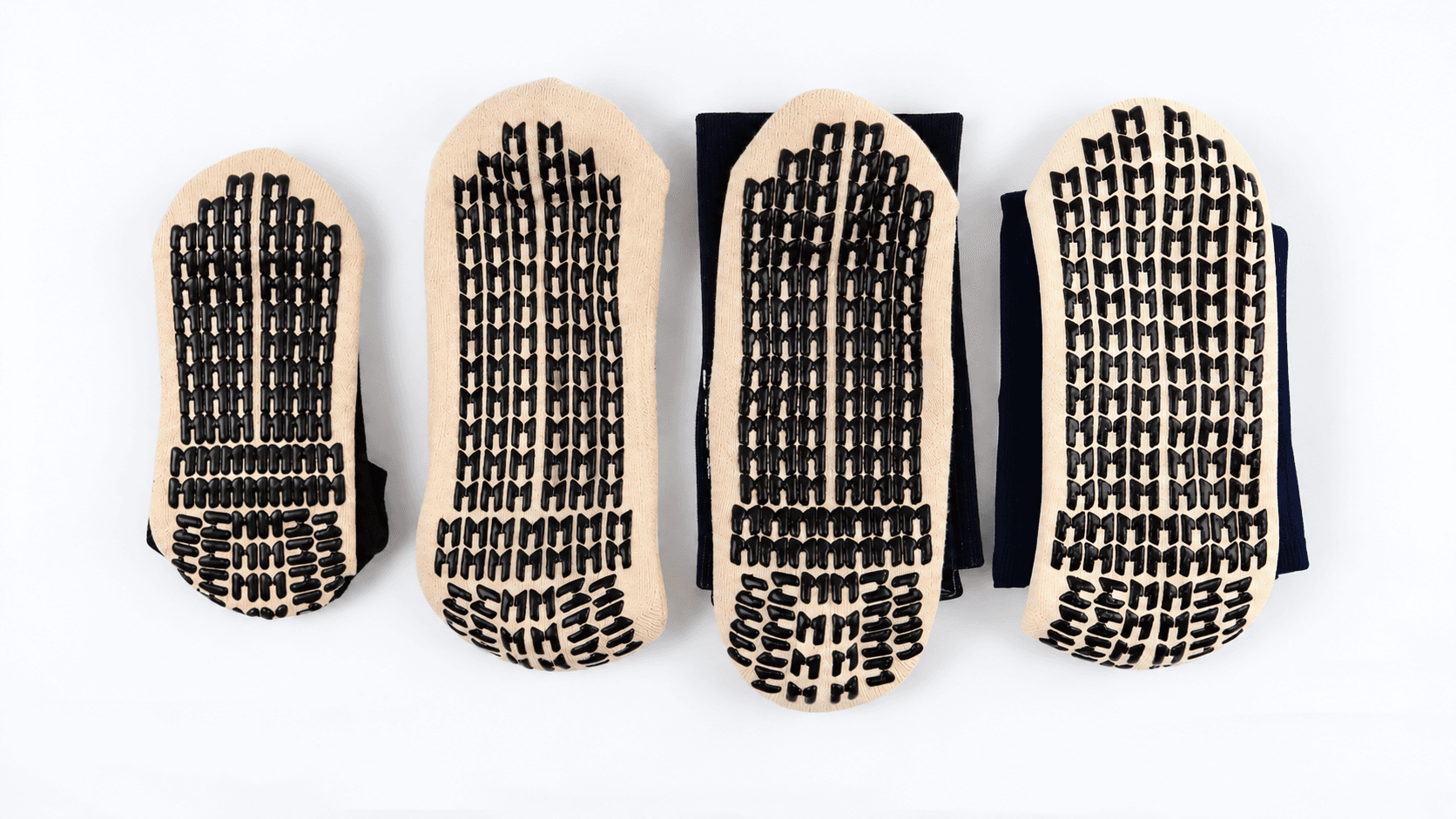
Crew and mid-calf grip socks call for checks on foot fit, cuff position, compression and grip placement. Knee-high team socks also need to account for shin guards, calf sizes, player height and any fold-over cuff. Explore the available custom grip socks options when choosing a construction.
Approve representative samples before bulk production
Check foot length, heel position, toe fit, cuff elasticity, calf fit, logo placement, grip position and overall comfort. Where practical, test players near both ends of each intended size range; one player near the middle cannot confirm the full range.
.png&w=3840&q=75)
.png&w=3840&q=75)
.png&w=3840&q=75)
.png&w=3840&q=75)
.png&w=3840&q=75)
For an academy, ask each squad manager to gather actual shoe sizes, convert them with the confirmed product chart, and consolidate matching style, color and size requirements where practical.
Example: a 120-pair football club order
A club has 40 players receiving two pairs each, so the player allocation is 80 pairs. It adds 40 pairs for replacement and future players. The final 120 pairs follow the actual size distribution:
| Size | Player allocation | Spare stock | Total pairs |
|---|---|---|---|
| Youth | 20 | 8 | 28 |
| Adult S/M | 38 | 18 | 56 |
| Adult L/XL | 22 | 14 | 36 |
| Total | 80 | 40 | 120 |
Spare sizes can cover new registrations, lost or damaged socks, tournaments and mid-season changes. Plan them using real player demand instead of dividing them equally.
.png&w=3840&q=75)
.png&w=3840&q=75)
.png&w=3840&q=75)
.png&w=3840&q=75)
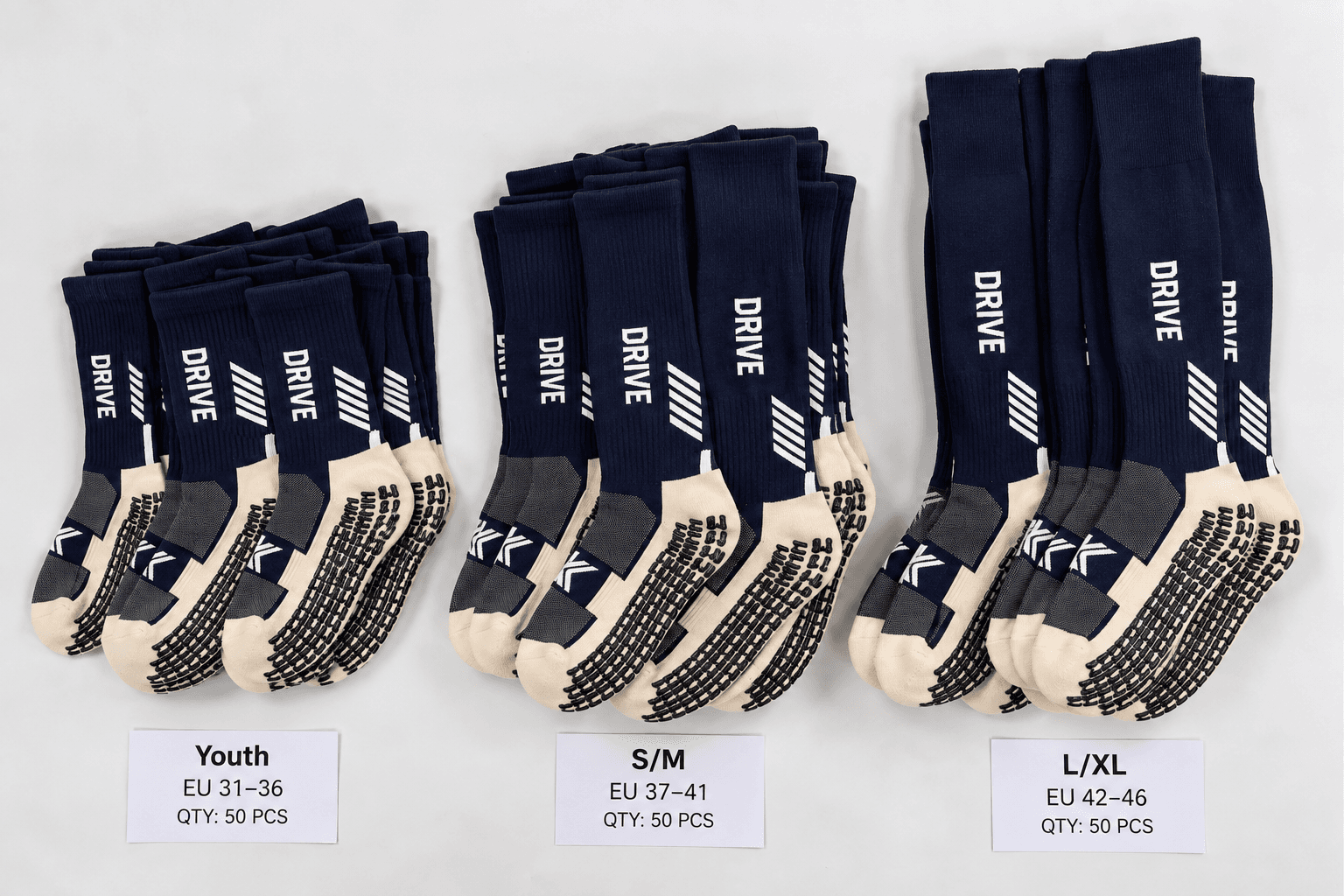
The bulk-order photos are supplied product examples. Confirm your own style, brand, quantities and labeling in the approved order specification.
Send a complete brief to your football socks manufacturer
Send your club logo, design and colors, sock style, player shoe-size breakdown, pairs required by size, grip and packaging requirements, destination and target delivery date. Confirm the size chart, size-level MOQ and sample fit before approving bulk production.
A good team order starts with player data and a confirmed product chart. This reduces size mistakes and makes repeat orders easier. You can also review our custom socks lead time guide to plan sampling and delivery.
Plan your club order
Planning custom football socks for your team?
Send your club logo, player size breakdown, estimated quantity, sock style and destination. PeakMotion can review the size mix, sampling route and bulk-order requirements.
Frequently asked questions
What sizes are available for custom football socks?
Available sizes depend on the sock style, knitting construction and manufacturer. Ask for the size chart for the specific product rather than relying on a universal chart.
Can kids and adult sizes use the same football sock design?
Often the same visual concept can be developed across multiple sizes, but logo proportions, grip placement and construction may require adjustment during sampling.
Can different football sock sizes be mixed within the MOQ?
This depends on the manufacturer’s MOQ structure and production setup. Confirm the size split before ordering.
How do I choose football sock sizes for an academy?
Collect each player’s shoe size, convert it using the manufacturer’s confirmed size chart, then consolidate quantities by sock size.
Should we order extra football socks?
Replacement inventory can be useful for new players, losses and mid-season requirements. The amount should reflect squad size, expected turnover and reorder lead time.
Should we sample every size before ordering?
For larger club or academy programs, testing representative sizes is useful, especially when developing a new construction or supplying children and adults under one program.