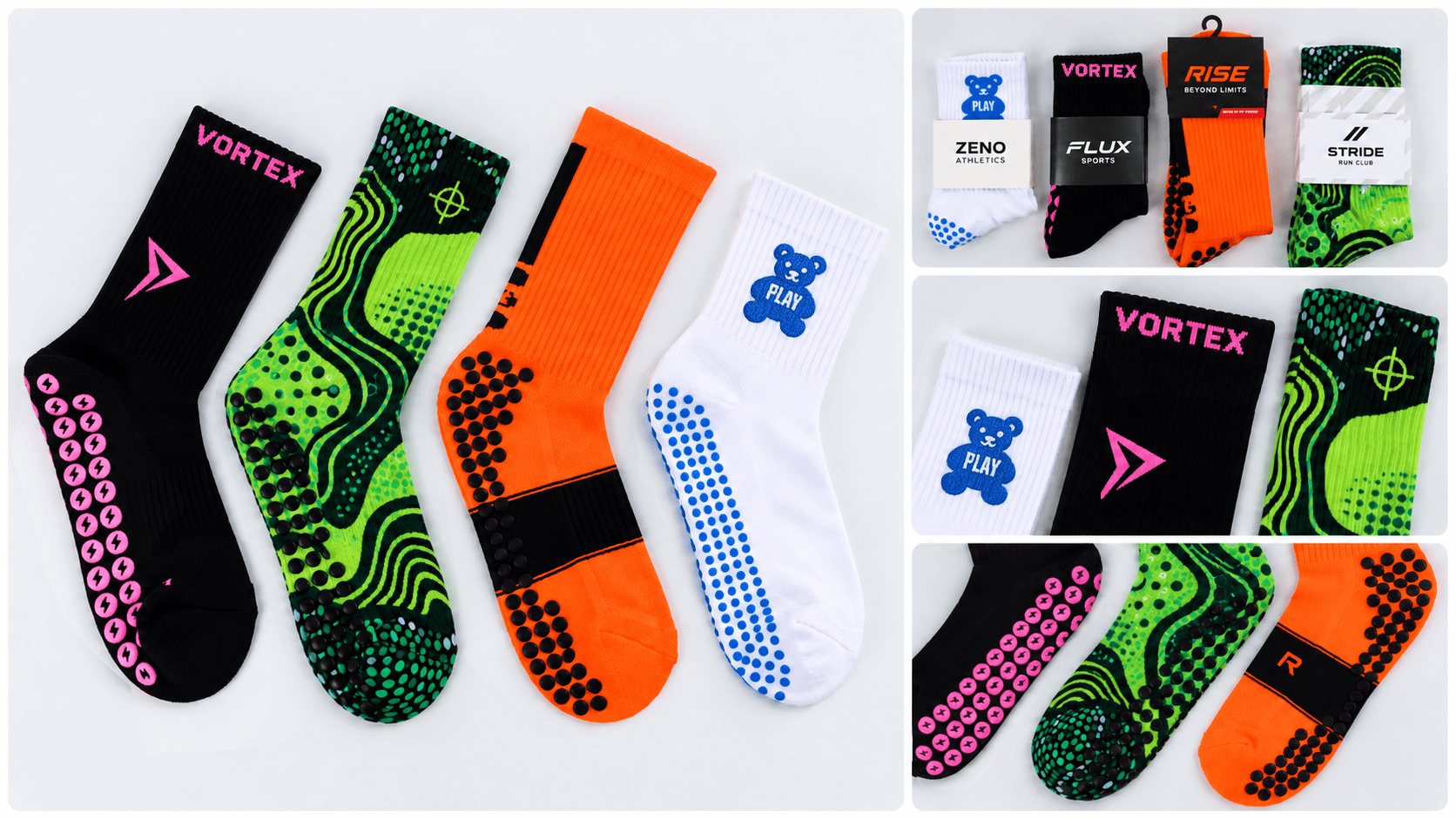
If you are sourcing grip socks for a sports brand, Pilates studio, football club or retail business, comparing supplier prices can quickly become confusing.
One manufacturer may quote a lower price per pair.
Another may appear more expensive but include better yarns, custom silicone grips, individual packaging or stronger quality control.
So what actually determines grip socks wholesale pricing?
The answer is more than order quantity.
Bulk grip sock cost is typically affected by:
- ✓Order volume
- ✓Sock construction
- ✓Yarn and material selection
- ✓Silicone grip coverage
- ✓Custom logo method
- ✓Number of colors and sizes
- ✓Packaging
- ✓Sampling and setup requirements
- ✓Shipping terms
- ✓Quality requirements
This guide explains how each factor affects your quotation and how to compare grip sock suppliers based on total value and landed cost, rather than simply choosing the lowest price per pair.
Grip Socks Wholesale Pricing: What Are You Actually Paying For?
A wholesale grip sock quotation usually combines several manufacturing costs.
These can include:
Materials — Yarns, elastic, silicone and reinforcement materials.
Production — Knitting, linking, finishing, boarding and grip application.
Customization — Logo development, custom colors, grip artwork and product specifications.
Packaging — Poly bags, paper bands, header cards, hang tags, labels or retail boxes.
Quality control — Inspection of sizing, knitting, grip placement, appearance and packing.
Order setup — Production planning, machine programming and preparation for each design or colorway.
This is why comparing two suppliers only by asking:
“What is your price per pair?”
can lead to a misleading comparison.
A better question is:
“What exactly is included in the quoted price?”
1. Order Quantity Has a Major Impact on Grip Socks Wholesale Pricing
Order volume is usually one of the strongest pricing factors.
A factory has setup work whether you order a relatively small batch or a much larger production run.
This may include:
- ✓Reviewing artwork
- ✓Preparing knitting programs
- ✓Selecting yarn
- ✓Setting machine parameters
- ✓Preparing grip artwork
- ✓Organizing packaging
- ✓Quality control setup
When these costs are spread across more pairs, the effective cost per unit can become lower.
This means that, in general:
Smaller quantity → higher cost per pair
Larger quantity → better production efficiency
However, the lowest unit price is not always the best business decision.
If you order 2,000 pairs only to get a lower unit cost but sell 300 pairs, the remaining stock becomes expensive inventory.
Wholesale pricing should therefore be evaluated together with:
- ✓Sales forecast
- ✓Cash flow
- ✓Inventory turnover
- ✓Storage cost
- ✓Reorder speed
For a new brand, a smaller but commercially sensible first order may be safer than maximizing volume purely for a lower factory price.
Ask for Quantity Break Pricing
Instead of requesting one quotation, ask your supplier to quote several quantities.
For example:
- ✓100 pairs
- ✓300 pairs
- ✓500 pairs
- ✓1,000 pairs
This allows you to see where the meaningful price breaks occur.
You may find that increasing from 100 to 500 pairs creates a noticeable unit-cost improvement, while increasing further produces a smaller benefit.
The most useful order quantity is therefore not always:
the largest quantity
but rather:
the quantity where pricing, margin and inventory risk are balanced.
2. Standard Grip Socks vs Fully Custom Grip Socks
Not every wholesale grip sock project uses the same production route.
This has a major effect on pricing.
Standard or Existing Construction
The supplier already has an established grip sock construction.
You may customize:
- ✓Logo
- ✓Color
- ✓Grip artwork
- ✓Packaging
This route can reduce product development work and may be suitable for brands that want to launch faster or test the market.
Fully Custom Construction
A fully customized program may involve changes to:
- ✓Sock height
- ✓Yarn composition
- ✓Cushioning
- ✓Compression
- ✓Mesh zones
- ✓Arch support
- ✓Toe construction
- ✓Cuff structure
- ✓Sizing
- ✓Grip placement
The more changes required, the more development and production planning may be involved.
Therefore, when comparing wholesale quotations, check whether suppliers are quoting:
the same level of customization.
A low-priced standard sock and a custom-developed performance grip sock are not equivalent products.
3. Silicone Grip Coverage Can Change the Cost
The grip itself is one of the most important cost variables in a grip sock.
Silicone usage can differ significantly between designs.
Common options include:
- ✓Small silicone dots
- ✓Large dots
- ✓Stripes
- ✓Geometric patterns
- ✓Custom logo grips
- ✓Heel-to-toe grip coverage
- ✓Full-sole grip patterns
A simple grip layout generally uses less silicone and requires less application work than a dense custom pattern.
For example:
Basic dot grip
may be simpler to produce than:
large multi-zone custom logo grip covering most of the sole.
The second design may require:
- ✓More silicone
- ✓More detailed artwork
- ✓Longer application time
- ✓More precise placement
- ✓Additional inspection
When requesting pricing, send your grip artwork or reference image.
Do not simply ask:
“How much are custom grip socks?”
The supplier cannot accurately compare grip cost without understanding the required coverage.
4. Grip Material Quality Matters
Two grip socks may look similar in a product photo but perform very differently after repeated use and washing.
When comparing wholesale pricing, ask what grip material is being used.
For performance-oriented products, buyers commonly look for grip systems that provide:
- ✓Consistent traction
- ✓Good elasticity
- ✓Strong adhesion
- ✓Wash durability
- ✓Comfortable feel
A cheaper quotation may sometimes reflect differences in grip formulation, application thickness or production quality.
For sports brands and studios, this is important because grip failure can lead to:
- ✓Customer complaints
- ✓Poor reviews
- ✓Returns
- ✓Replacements
- ✓Damage to brand reputation
The cheapest grip application is not automatically the lowest-cost option over the life of the product.
5. Yarn and Material Selection Affect Price
Grip sock wholesale pricing also depends on the sock body.
Common yarn choices include:
- ✓Cotton blends
- ✓Polyester
- ✓Nylon
- ✓Spandex
- ✓Performance yarns
- ✓Recycled fibers
- ✓Specialty fibers
Different yarns have different raw-material costs and performance characteristics.
A studio grip sock focused on softness may use a different construction from a football grip sock designed for moisture management and durability.
When choosing yarn, consider what the customer actually needs.
Pilates and Yoga
Priorities may include:
- ✓Soft feel
- ✓Breathability
- ✓Stretch
- ✓Comfortable cuff
- ✓Secure grip
Football
Priorities may include:
- ✓Thin construction
- ✓Moisture management
- ✓Close fit
- ✓Durability
- ✓Grip inside the boot
Gym and Training
Priorities may include:
- ✓Cushioning
- ✓Support
- ✓Sweat management
- ✓Durability
There is little value in paying for technical materials your customer does not need.
But using an unsuitable low-cost yarn purely to reduce price can also hurt product performance.
6. Cushioning, Compression and Technical Features Add Complexity
The internal construction of a grip sock can also influence manufacturing cost.
Features may include:
- ✓Terry cushioning
- ✓Arch compression
- ✓Ribbed support
- ✓Mesh ventilation
- ✓Heel reinforcement
- ✓Toe reinforcement
- ✓Anatomical fit zones
- ✓Extra elastic support
A simple sock with basic knitting normally requires less production complexity than a technical sports sock with multiple performance zones.
This does not mean more features are always better.
A good wholesale product is designed around the intended use.
For example, a thick cushioned grip sock may work well for certain training environments but may be unsuitable inside a tight football boot.
Choose the specification first.
Then compare pricing for that same specification.
7. Custom Logo Method Affects Wholesale Cost
Branding is another pricing variable.
A custom grip sock may use:
- ✓Jacquard knitted logo
- ✓Embroidery
- ✓Printed logo
- ✓Silicone logo
- ✓Custom sole grip logo
- ✓Branded label
Each method has different production requirements.
Knitted Logo
A logo is integrated directly into the knitted sock structure.
This is commonly used for branded sports socks.
Printed Logo
Printing can provide flexibility for certain artwork styles and placements.
Embroidery
Embroidery creates a distinctive raised appearance but adds another production process.
Silicone Logo
Some brands use their logo as part of the grip pattern itself.
This can create a strong branded appearance on the sole but may require custom artwork preparation and a more complex grip application.
When comparing supplier quotations, make sure the logo method is identical.
Otherwise, you may be comparing two completely different production specifications.
8. More Colors Can Increase Production Complexity
A buyer might request:
500 pairs total
but divide the order across:
- ✓Black
- ✓White
- ✓Grey
- ✓Pink
- ✓Blue
This is different from producing 500 pairs in one color.
Every additional colorway may affect:
- ✓Yarn preparation
- ✓Machine setup
- ✓Production scheduling
- ✓Grip color
- ✓Labeling
- ✓Packing
This is one reason the quantity per design and per color matters when requesting wholesale pricing.
A factory may quote differently for:
500 pairs × 1 color
versus:
500 pairs ÷ 5 colors
even though the total quantity is identical.
9. Size Breakdown Also Matters
Grip socks are often offered in several sizes.
For example:
- ✓S/M
- ✓M/L
- ✓L/XL
A wider size range improves market coverage, but it also creates more SKUs.
Consider a 300-pair order.
With one color and two sizes:
150 pairs per size
With three colors and three sizes:
around 33 pairs per SKU
The total order is still 300 pairs, but production and inventory are much more fragmented.
For an early-stage brand, limiting the first collection to the most important colors and sizes can make both pricing and inventory management easier.
10. Custom Packaging Can Significantly Change the Quote
Packaging is often underestimated when buyers compare wholesale pricing.
The grip socks themselves may be competitively priced, but custom retail packaging adds another cost layer.
Common options include:
- ✓Standard polybag
- ✓Custom polybag
- ✓Paper band
- ✓Header card
- ✓Hang tag
- ✓Barcode sticker
- ✓Size label
- ✓Retail box
Packaging may involve:
- ✓Graphic design
- ✓Printing
- ✓Material cost
- ✓Minimum print quantities
- ✓Manual packing
- ✓Barcode application
For an online brand, simple branded packaging may be enough.
For retail stores, distributors or studio displays, a header card or retail-ready package may be more appropriate.
Tell the supplier your sales channel before selecting packaging.
11. Packaging MOQ Can Be Different From Sock MOQ
This is an important point for new buyers.
Your sock supplier may accept a certain production quantity, but printed packaging suppliers can have their own MOQ requirements.
For example, the sock production route may support a relatively small test order while fully customized printed boxes require a larger print quantity.
This can affect the overall economics of a first order.
For smaller launches, consider whether you really need fully custom packaging immediately.
A simpler option such as:
- ✓Standard bag
- ✓Branded sticker
- ✓Paper band
- ✓Simple header card
may provide enough branding without adding unnecessary packaging cost.
12. Sample and Development Costs Should Be Included in Your Budget
Before bulk production, you may need a physical sample.
Sampling is particularly important when you are developing:
- ✓Custom grip patterns
- ✓New colors
- ✓Technical constructions
- ✓New sizing
- ✓Private label packaging
Do not compare only the bulk price and ignore product development.
Ask the supplier:
- ✓Is there a sample fee?
- ✓Is shipping included?
- ✓How many revisions are included?
- ✓Is the sample fee refundable after a bulk order?
- ✓How long does sampling take?
A slightly higher sample cost may be worthwhile if it helps prevent a much more expensive error during bulk production.
13. Unit Price Is Not the Same as Landed Cost
This is one of the most important concepts in wholesale sourcing.
A supplier might quote:
Product price: $X per pair
But that is not necessarily your final cost.
Your landed cost may include:
Factory product price
Packaging
Shipping
Import duty
Taxes
Customs clearance
Local transportation
=
Actual landed cost per pair
This is the number you should use when calculating retail margin.
14. EXW, FOB and DDP Quotes Are Not Directly Comparable
Wholesale buyers sometimes compare two prices without realizing that the shipping terms are different.
For example:
EXW
The price may cover goods collected from the factory, while the buyer handles much of the freight process.
FOB
The supplier typically handles the goods through the agreed export port stage according to the shipping term.
DDP
The quotation can include much more of the delivery process to the destination, depending on the specific agreement.
A DDP price will naturally appear higher than a basic factory price.
That does not mean the supplier is more expensive.
Before comparing quotations, make sure you understand:
- ✓Incoterm
- ✓Shipping method
- ✓Destination
- ✓Duties
- ✓Taxes
- ✓Delivery responsibilities
Compare like with like.
15. Air Freight vs Sea Freight Changes the Economics
Shipping method can significantly affect landed cost.
Express Courier
Suitable for:
- ✓Samples
- ✓Small orders
- ✓Urgent launches
Fast, but usually expensive per kilogram.
Air Freight
Can be useful for commercial orders where speed matters.
Sea Freight
Often more economical for larger shipments, but transit times are longer.
For small grip sock orders, freight may represent a noticeable share of the landed cost per pair.
For larger orders, shipping efficiency can improve.
That is another reason to compare total landed cost at different quantity levels.
16. Why the Cheapest Supplier Can Become the Most Expensive
Imagine Supplier A offers a very low unit price.
After production, you discover:
- ✓Grip placement is inconsistent
- ✓Sizes vary
- ✓Logos are distorted
- ✓Packaging is damaged
- ✓Silicone starts peeling
- ✓Pair matching is inconsistent
Now your business may face:
- ✓Rework
- ✓Replacements
- ✓Refunds
- ✓Customer service costs
- ✓Lost reviews
- ✓Delayed launches
A slightly higher manufacturing price may provide better commercial value if the supplier delivers more consistent quality.
When comparing grip socks wholesale pricing, evaluate:
price + quality + consistency + service + delivery reliability
rather than price alone.
17. Quality Control Should Be Part of the Price Comparison
Ask a prospective supplier how bulk orders are inspected.
Grip sock QC may include checking:
- ✓Sock measurements
- ✓Color consistency
- ✓Logo placement
- ✓Knitting defects
- ✓Pair matching
- ✓Silicone grip position
- ✓Grip appearance
- ✓Packaging
- ✓Quantity
For a custom product, the approved sample should act as an important production reference.
The goal is not simply to manufacture the lowest-cost pair.
It is to manufacture the product consistently enough that you can confidently put your brand name on it.
18. First Orders and Repeat Orders May Have Different Economics
Your first production order often involves more development work.
A repeat order may already have:
- ✓Approved knitting program
- ✓Confirmed yarn colors
- ✓Approved size specification
- ✓Final logo artwork
- ✓Approved grip design
- ✓Packaging files
This can make the reorder process easier to plan.
When discussing wholesale pricing, ask your supplier:
“If this product sells well, what would pricing look like at higher reorder quantities?”
For example:
- ✓Initial order: 100–300 pairs
- ✓Reorder: 500 pairs
- ✓Scale order: 1,000+ pairs
This gives you a better understanding of how your unit economics could improve as the business grows.
19. How Retailers Should Evaluate Grip Sock Wholesale Pricing
Retailers need enough gross margin to cover:
- ✓Marketing
- ✓Store fees
- ✓Payment processing
- ✓Staff
- ✓Returns
- ✓Fulfillment
- ✓Rent or platform fees
A low wholesale price alone does not guarantee profitability.
Start with your target retail price.
Then work backwards.
For example:
Target retail price
−
Required gross margin
−
Landed product cost
−
Operating costs
=
Sustainable product economics
This is much more useful than choosing a product first and trying to make the numbers work later.
20. How Pilates Studios Should Evaluate Bulk Grip Sock Cost
For Pilates studios, grip socks can serve two purposes:
- ✓Member equipment
- ✓Retail merchandise
A studio should therefore consider:
- ✓Member demand
- ✓Monthly class volume
- ✓Retail selling price
- ✓Size distribution
- ✓Color preferences
- ✓Studio branding
- ✓Reorder frequency
Instead of launching ten colors immediately, a studio could begin with:
- ✓One or two core colors
- ✓Two practical sizes
- ✓One recognizable grip design
- ✓Simple branded packaging
Then use real retail sales to plan the next production run.
This can reduce both SKU complexity and unsold inventory.
21. How Football Brands and Clubs Should Evaluate Pricing
Football grip socks have different performance requirements from many studio products.
Important cost factors may include:
- ✓Thin technical construction
- ✓Moisture management
- ✓Compression
- ✓Grip coverage
- ✓Durability
- ✓Team colors
- ✓Multiple sizes
A football club should also consider whether the socks will be:
- ✓Sold individually
- ✓Included in player kits
- ✓Used for academies
- ✓Distributed for tournaments
- ✓Sold through a club store
The intended use can affect both the required specification and the appropriate bulk quantity.
How to Lower Grip Socks Wholesale Cost Without Hurting Quality
Reducing cost does not always mean reducing product quality.
A better approach is to remove unnecessary complexity.
1. Start With Fewer Colors
Launch the strongest one or two colors first.
2. Limit the Number of SKUs
Avoid too many size × color × design combinations in the first order.
3. Use a Proven Sock Construction
If you do not need a completely bespoke structure, an existing manufacturing base can simplify development.
4. Keep Grip Artwork Practical
A clear, effective grip design may cost less to produce than an unnecessarily complex full-sole pattern.
5. Simplify First-Order Packaging
Use packaging that fits your sales channel rather than paying for elaborate retail boxes immediately.
6. Ask for Quantity Breaks
Compare 100, 300, 500 and 1,000-pair pricing before choosing your order quantity.
7. Plan Reorders Early
A reliable reorder forecast can help prevent expensive rush production and urgent freight.
The goal is not to make the cheapest grip sock possible.
It is to achieve:
the right product at the right landed cost for your market.
How to Compare Grip Socks Wholesale Quotes
When comparing suppliers, create a simple quotation sheet.
This prevents an apparently low price from hiding important differences.
What to Send a Supplier for an Accurate Grip Socks Wholesale Quote
The more complete your inquiry, the more useful the quotation will be.
Send:
Product Type
For example:
- ✓Pilates grip socks
- ✓Yoga grip socks
- ✓Football grip socks
- ✓Training grip socks
Reference Photo or Drawing
Show the construction you want.
Logo File
Ideally provide clear vector artwork.
Target Quantity
For example:
Please quote 100, 300 and 500 pairs.
Colors
Specify the number of colorways.
Sizes
Share your required size split.
Grip Design
Send a grip reference or custom artwork.
Packaging
Explain whether you need:
- ✓Basic packing
- ✓Paper band
- ✓Header card
- ✓Hang tag
- ✓Retail box
Delivery Country
This helps the supplier discuss shipping options.
Required Delivery Date
If your launch date is fixed, mention it from the beginning.
A detailed RFQ is much more likely to receive a useful commercial quotation than:
“Hi, price?”
Frequently Asked Questions About Grip Socks Wholesale Pricing
How much do wholesale grip socks cost?
There is no single wholesale price for grip socks. Pricing depends on order quantity, sock construction, yarn, silicone grip coverage, branding, colors, sizes, packaging and shipping terms. Request a quotation based on your actual specification rather than relying only on a generic per-pair price.
Does ordering more grip socks reduce the price per pair?
Larger quantities can improve production efficiency because setup and other costs are spread across more units. However, the best order quantity should also consider inventory risk and expected sales.
What affects custom silicone grip pricing?
Grip coverage, pattern complexity, silicone quantity, color requirements and custom logo artwork can all affect production cost.
Are custom grip socks more expensive than standard wholesale grip socks?
They can be. Custom yarns, construction, colors, logo methods, grip artwork and packaging may add production steps compared with an existing standard product.
Does custom packaging increase the wholesale price?
Yes. Header cards, paper bands, printed bags, hang tags, barcode labels and retail boxes add material and packing costs. Packaging may also have its own MOQ.
What is the MOQ for wholesale grip socks?
MOQ depends on the product route and customization level. Existing styles with straightforward customization may support lower quantities, while fully bespoke constructions, special materials or custom packaging can require higher minimums.
Should I choose the supplier with the lowest price?
Not automatically. Compare specification, materials, grip quality, QC, packaging, lead time, shipping terms and landed cost before deciding.
What information is needed for a grip sock quotation?
Send the supplier your intended sock type, artwork, logo, quantity, colors, sizes, grip requirements, packaging, destination and required delivery date.
Compare Grip Socks Wholesale Pricing Based on Total Value
The best grip socks wholesale pricing is not necessarily the lowest number on a quotation.
A useful sourcing decision considers:
- ✓Product specification
- ✓Quantity
- ✓Material
- ✓Grip quality
- ✓Custom branding
- ✓Packaging
- ✓Quality control
- ✓Shipping
- ✓Landed cost
- ✓Inventory risk
For a new brand, the right approach may be a focused first order with limited SKUs.
For an established studio, retailer or sports brand, a larger bulk order may provide stronger unit economics.
The key is to compare the same specification at several quantity levels.
PeakMotion supports custom and private label grip sock programs for sports brands, Pilates studios, football clubs, retailers and distributors.
To receive a project-specific quotation, send us:
- ✓Your grip sock reference
- ✓Logo or artwork
- ✓Target quantity
- ✓Size breakdown
- ✓Colors
- ✓Grip requirements
- ✓Packaging needs
- ✓Delivery country
We can then review the specification and recommend a practical production and pricing route.
Explore Custom Grip Socks
See Custom Grip Sock Price Planning
Compare Custom Socks MOQ Options
Request Wholesale Pricing